Toroweap or the South Rim? Choosing Your Grand Canyon Overlook
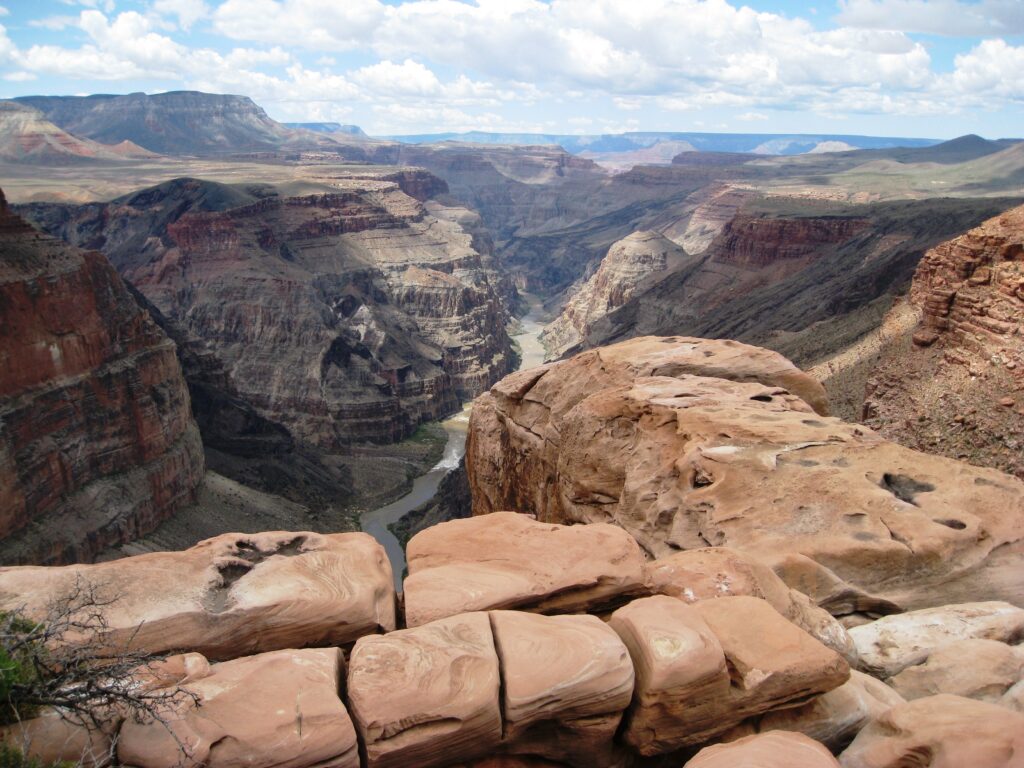
Two viewpoints, one canyon, and almost nothing in common. The Grand Canyon’s South Rim is the postcard version: paved lookouts, guardrails, a shuttle bus, and some of the busiest overlooks in the national park system. Toroweap is the opposite in nearly every way. It sits far out on the remote edge of the Toroweap overlook above the Colorado River, reached by long dirt roads, with no railings, no services, and rarely a crowd. Both deliver the canyon. They just ask very different things of you to get there.
If you’re trying to decide between them, the honest answer is that they suit different kinds of travelers. Here’s how to tell which one is yours.
What makes Toroweap so different
Toroweap, sometimes spelled Tuweep, is one of the most dramatic viewpoints along the Grand Canyon’s North Rim side. What sets it apart isn’t the size of the view but its sheer vertical drama. Instead of looking out across a wide, terraced canyon, you stand at the lip of a cliff that falls almost straight down to the river roughly 3,000 feet below. Photographers and adventurers prize it for exactly this reason: there’s nothing quite like peering over an edge that goes nearly straight to the water.
That same quality is what makes it serious. There are no guardrails, no fences, and no one nearby to help if something goes wrong. The drop is real and unforgiving. Children, dogs, and anyone uneasy with heights should be kept well back from the rim.
Toroweap rewards self-reliance. Its remoteness is the whole point — the isolation is what keeps it quiet and untouched — but isolation cuts both ways when you’re a long way from pavement.
What the South Rim offers instead
The developed South Rim is built for visitors. You’ll find paved overlooks, marked trails, guardrails at the edges, a visitor center, lodging, food, water, restrooms, and park staff on hand. You can drive in on a maintained highway, park, and walk a few steps to a railed viewpoint. For families, older travelers, first-time canyon visitors, or anyone short on time, that infrastructure is a genuine gift.
The trade-off is people. The South Rim draws large crowds, especially in summer, and the popular overlooks can feel busy. The view is magnificent and panoramic, but you’ll be sharing it. If your idea of the Grand Canyon includes solitude, the South Rim won’t deliver that the way a remote overlook can.
Getting there: the real deciding factor
Access is where most people make their choice, and it should be.
- South Rim: paved roads, signed routes, fuel and supplies along the way. Any vehicle can make the trip.
- Toroweap: long, unpaved roads across open Arizona Strip country, with no services once you leave town. Conditions vary with weather, and the final stretch is rough. A high-clearance vehicle is the sensible choice, and you should not count on cell signal.
Because Toroweap sits deep in the country managed within Grand Canyon–Parashant National Monument, you’re genuinely on your own out there. Carry plenty of water, food, a full tank of fuel, a spare tire you know how to change, and a paper map or downloaded offline maps. Tell someone your plan and when you expect to be back. Before you commit, check current road and weather conditions — a road that’s fine when dry can turn impassable after rain.
The South Rim asks for none of this. That difference, more than the view itself, is what should drive your decision.
Which one should you choose?
Choose the South Rim if you want a reliable, comfortable visit. It’s the right call for first-timers, families with kids, travelers with limited time, anyone driving a standard car, and visitors who’d rather not worry about logistics. You’ll get a world-class panorama with a safety net.
Choose Toroweap if you’re an experienced, self-sufficient traveler who wants a wild, uncrowded edge of the canyon and is genuinely prepared for backcountry conditions. It suits photographers chasing a one-of-a-kind vertical shot and adventurers who treat the journey as part of the reward. Go in with a capable vehicle, real supplies, and a clear-eyed respect for the unguarded rim.
There’s no wrong answer here — only a right one for your group, your vehicle, and your appetite for remoteness.
Plan it from the Arizona Strip
If Toroweap is on your list, it makes sense to base your trip in the surrounding region, where you can fuel up, stock up, and stage for the drive. Gateway towns like Fredonia and nearby Kanab put you closest to the North Rim side of the canyon, while communities such as Mesquite anchor the western Strip. From here you can build an itinerary that pairs a canyon overlook with other regional draws — browse our landmarks and recreation guides to round out the trip.
Whichever rim you choose, treat the canyon with the respect it deserves: stay back from unprotected edges, carry more water than you think you’ll need, and check conditions before you go. The view will still be there. Make sure you get home to tell people about it.